

Workforce scheduling remains one of the most complex operational challenges facing Australian businesses today. Whether managing a healthcare facility with round-the-clock shifts, coordinating retail staff across multiple locations, or balancing hospitality rosters during peak seasons, the mathematics of optimal scheduling quickly becomes overwhelming. Traditional manual rostering methods consume countless hours of management time while frequently producing suboptimal results that fail to balance business needs, employee preferences, regulatory compliance, and cost efficiency.
Roster optimisation represents a fundamental shift from reactive, manual scheduling to proactive, algorithm-driven workforce planning.By leveraging sophisticated mathematical techniques and automation, organisations can transform rostering from a time-consuming administrative burden into a strategic advantage that simultaneously reduces labour costs,improves employee satisfaction, ensures regulatory compliance, and enhances operational efficiency.
This comprehensive guide examines the principles,technologies, and practical applications of roster optimisation for Australian businesses, with particular attention to the unique compliance requirements imposed by Modern Awards and Enterprise Bargaining Agreements.
Roster optimisation applies advanced mathematicalalgorithms to solve complex scheduling problems by simultaneously consideringmultiple competing constraints and objectives. Unlike basic scheduling softwarethat simply allows managers to fill shifts, optimisation engines mathematicallycalculate the best possible roster configuration from millions of potentialcombinations.
The fundamental challenge in workforce scheduling stems from its computational complexity. Even a modest organisation with fifty employees, seven-day operations, and three shift types faces over 10^50possible roster combinations. Evaluating each possibility manually remains impossible, yet traditional scheduling approaches essentially rely on managers making educated guesses about which combination might work best.
Optimisation algorithms approach this challenge systematically. These mathematical techniques evaluate constraints (hard rules that cannot be violated) and objectives (goals to maximise or minimise) to identify roster configurations that satisfy all requirements while achieving the best possible outcome according to defined criteria. Modern optimisation engines can process these calculations in seconds, identifying solutions that would take humans weeks or months to discover through trial and error.
Australian organisations implementing roster optimisation typically realise benefits across four key dimensions: cost reduction, time savings, compliance assurance, and employee satisfaction.
Cost reduction emerges as the most immediately measurable benefit. Optimisation algorithms minimise unnecessary overtime, reduce overstaffing during quiet periods, and ensure skill-appropriate allocation of staff to tasks. Organisations commonly report labour cost reductions between four and twenty-five percent following optimisation implementation. These savings stem not from reducing headcount but from eliminating inefficiencies in how existing staff are scheduled.
Time savings prove equally substantial. Managers who previously spent ten to twenty hours per week on manual rostering can redirect this time toward higher-value activities. The automation of routine scheduling decisions, conflict resolution, and compliance checking eliminates the repetitive administrative work that consumes management capacity.
Compliance assurance addresses one of the most significant risks facing Australian employers. Modern Awards contain complex provisions regarding minimum rest periods, maximum consecutive shifts, overtime triggers, penalty rate calculations, and numerous other requirements that vary by industry, employee classification, and specific circumstances. Manual rostering struggles to consistently apply these rules across hundreds or thousands of scheduling decisions. Optimisation systems encode these requirements as mathematical constraints, ensuring every generated roster maintains full compliance.
Employee satisfaction improves when optimisation systems consider worker preferences, ensure fair distribution of desirable and undesirable shifts, and provide greater schedule predictability. Research consistently demonstrates that employees value schedule stability and fairness more highly than marginal wage increases. Organisations implementing optimisation with employee preference consideration typically observe reduced turnover, decreased absenteeism, and improved engagement.
Distinguishing truly sophisticated optimisation platforms from basic scheduling software requires understanding several critical capabilities.
Constraint satisfaction represents the foundation of any optimisation system. The platform must handle both hard constraints (absolute requirements that cannot be violated) and soft constraints (preferences to satisfy when possible). Hard constraints include regulatory requirements such as minimum rest periods, maximum shift lengths, required qualifications for specific roles, and contractual obligations. Soft constraints encompass employee preferences, fairness considerations, and operational preferences.
Multi-objective optimisation enables balancing competing goals simultaneously. Real-world rostering requires optimising for multiple objectives: minimising labour costs, maximising coverage quality, balancing workload distribution, accommodating employee preferences, and reducing administrative burden. Advanced optimisation engines assign relative weights to these objectives and identify roster configurations representing the best achievable compromise across all dimensions.
Award interpretation capability proves essential in the Australian context. Modern Awards contain extraordinarily complex provisions that vary based on employee classification, shift timing, work patterns, and numerous other factors. Optimisation systems must accurately interpret these provisions and incorporate them as constraints during roster generation. This capability extends beyond simple rule application to understanding the interaction between multiple award clauses and identifying the correct interpretation when provisions conflict or overlap.
Scenario modelling allows organisations to evaluate the impact of proposed changes before implementation. Whether assessing a new Enterprise Bargaining Agreement, evaluating extended operating hours, or planning for seasonal demand fluctuations, scenario modelling enables comparing multiple roster configurations to identify the optimal approach.
Integration capability ensures optimisation systems work seamlessly with existing HR, payroll, and time-and-attendance platforms. Data flows automatically between systems, eliminating manual data entry and ensuring roster decisions reflect current employee information, leave balances, qualification status, and other relevant factors.
Understanding the distinction between roster optimisationand conventional scheduling tools proves critical when evaluating solutions.
Traditional scheduling software provides digital tools for managers to create rosters manually. These platforms offer calendars, drag-and-drop interfaces, and basic conflict detection, but fundamentally rely on human decision-making to determine who works when. The software facilitates roster creation but does not generate optimal schedules automatically.
Roster optimisation platforms employ mathematical algorithms to automatically generate optimal rosters based on defined constraints and objectives. Rather than providing tools for manual scheduling, these systems solve the scheduling problem computationally, producing roster configurations that provably satisfy all requirements while achieving the best possible outcome according to specified criteria.
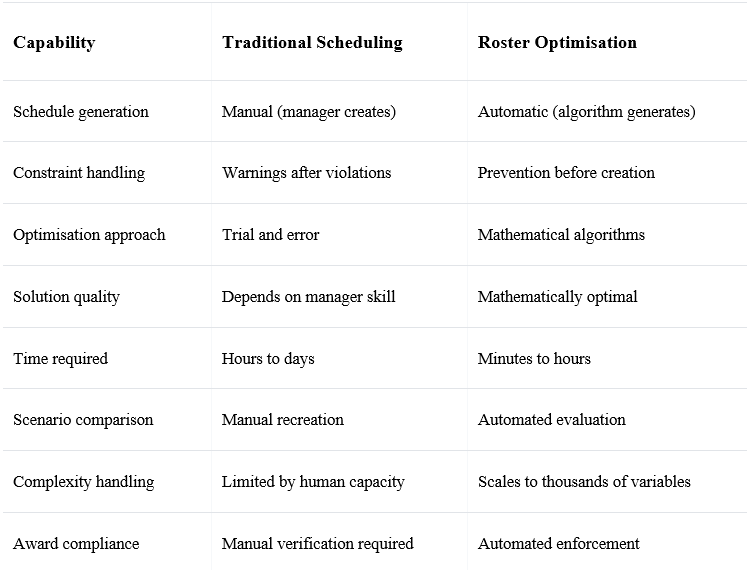
This distinction matters enormously for organisations with complex scheduling requirements. While traditional scheduling software may suffice for simple environments with minimal constraints, optimisation becomes essential when balancing dozens of requirements across large workforces.
Organisations implementing roster optimisation frequently encounter several challenges that require careful consideration during deployment.
Data quality represents the most common implementation obstacle. Optimisation algorithms require accurate information about employee qualifications, availability, contractual requirements, and operational needs. Incomplete or inaccurate data produces suboptimal results regardless ofalgorithm sophistication. Successful implementations prioritise data cleansing and validation before optimisation deployment.
Change management proves critical when transitioning from manual to automated rostering. Managers accustomed to creating schedules manually may initially resist algorithmic decision-making, particularly when optimisation produces rosters that differ from historical patterns. Effective change management emphasises that optimisation augments rather than replaces human judgment, with managers retaining authority to adjust algorithmically-generated rosters when business circumstances require.
Preference balancing requires establishing clear policies about how employee preferences factor into optimisation. Unlimited preference accommodation proves impossible when preferences conflict with operational requirements or create inequitable outcomes. Organisations must define which preferences receive priority, how conflicts are resolved, and what constitutes fair distribution of desirable shifts.
Award complexity challenges even sophisticated optimisation systems when interpreting Australia's Modern Award provisions. Awards contain provisions that interact in complex ways, with interpretation sometimes requiring judgment about legislative intent. Optimisation systems must encode these interpretations accurately while remaining flexible enough to accommodate award updates and variations.
Different industries face distinct rostering challenges that optimisation addresses through specialised approaches.
Healthcare organisations manage perhaps the most complex scheduling environments, with twenty-four-hour operations, strict qualification requirements, fatigue management regulations, and highly variable demand patterns. Optimisation systems for healthcare must balance clinical coverage requirements, ensure appropriate skill mix across shifts, comply with safe staffing ratios, and manage on-call arrangements while controlling overtime costs. Advanced healthcare optimisation incorporates demand forecasting to align staffing levels with predicted patient volumes, reducing both understaffing and overstaffing.
Retail environments face highly seasonal demand, part-time workforces with variable availability, and the need to match staffing levels with customer traffic patterns. Retail optimisation focuses on aligning labour deployment with sales forecasts, ensuring adequate coverage during peak periods while minimising costs during quiet times. Integration with point-of-sale systems enables optimisation based on actual transaction data rather than estimates.
Hospitality operations combine elements of both healthcare and retail challenges, with variable demand patterns, mixed full-time and casual workforces, and complex award provisions regarding penalty rates and minimum shift lengths. Hospitality optimisation must account for different skill requirements across roles (kitchen, service, bar), manage split shifts appropriately, and optimise the mix of permanent and casual staff to balance cost and flexibility.
Manufacturing environments typically operate fixed shift patterns but must optimise crew composition, manage planned maintenance shutdowns, and balance workload across production lines. Manufacturing optimisation focuses on ensuring required skills are available for each production run, managing shift rotations fairly, and minimising disruption during changeovers.
Organisations must establish clear metrics to evaluate optimisation effectiveness and demonstrate return on investment.
Labour cost per unit of output provides the most direct measure of optimisation impact. Whether measuring cost per patient day, cost per transaction, or cost per production unit, this metric captures whether optimisation successfully reduces the labour input required to deliver services or produce goods.
Rostering time reduction quantifies the administrative efficiency gained through automation. Organisations should measure hours spent on roster creation, adjustment, and conflict resolution before and after optimisation implementation.
Compliance rate tracks the percentage of roster periods that fully comply with all award requirements, contractual obligations, and regulatory provisions. This metric should approach one hundred percent following optimisation deployment.
Employee satisfaction scores measure whether optimisation improves worker experience through fairer shift distribution, better preference accommodation, and greater schedule predictability. Regular pulse surveys focused specifically on scheduling satisfaction provide this data.
Overtime percentage indicates whether optimisation successfully minimises unnecessary overtime while maintaining required coverage. Significant overtime reduction typically occurs following optimisation implementation as algorithms identify more efficient staffing patterns.
Organisations evaluating roster optimisation platforms should assess several critical factors beyond basic functionality.
Algorithm sophistication determines solution quality. Organisations should inquire about the specific optimisation techniques employed (linear programming, constraint programming, genetic algorithms, or hybrid approaches) and request evidence of the solution's ability to handle complex, real-world scenarios. Vendors should demonstrate optimisation performance on problems similar to your organisation's specific challenges.
Award coverage proves essential for Australian organisations. Solutions must demonstrate comprehensive coverage of relevant Modern Awards or Enterprise Agreements, with clear documentation of how award provisions are interpretedand applied. Organisations should request detailed mapping of award clauses to system constraints and verify interpretation accuracy with industrial relations experts.
Implementation methodology significantly impacts deployment success. Effective implementations follow structured approaches that prioritise data preparation,include comprehensive testing with historical scenarios, provide extensive user training, and offer ongoing optimisation tuning as organisational needs evolve.
Vendor expertise matters enormously in this specialised domain. Organisations should evaluate vendor experience with similar organisations, assess the depth of their industrial relations knowledge, and verify their capability to provide ongoing support as awards change and organisational requirements evolve.
Integration architecture determines how seamlessly optimisation connects with existing systems. Modern platforms should offer pre-built integrations with major HR and payroll systems, provide robust APIs for custom integrations, and support automated data synchronisation to eliminate manual data transfer.
Roster optimisation continues evolving rapidly as new technologies and techniques emerge.
Artificial intelligence increasingly augments traditional optimisation algorithms. Machine learning models predict demand patterns more accurately, identify subtle patterns in employee preferences, and recommend constraint adjustments to improve solution quality. AI-powered systems learn from historical roster performance to continuously refine optimisation parameters.
Real-time optimisation enables dynamic roster adjustment as circumstances change. Rather than generating static rosters for future periods, emerging systems continuously re-optimise as employees call in sick, demand fluctuates, or other disruptions occur. This capability transforms rostering from periodic planning to continuous adaptation.
Predictive analytics allows organisations to anticipate schedulingchallenges before they materialise. By analysing historical patterns, thesesystems identify periods likely to experience coverage difficulties, predictwhich employees may be at risk of burnout based on scheduling patterns, andrecommend proactive interventions.
Employee self-service increasingly integrates with optimisation engines, allowing workers to submit preferences, request shift swaps, and bid for available shifts within parameters defined by optimisation constraints. This approach combines algorithmic efficiency with employee autonomy, improving both operational efficiency and worker satisfaction.
Roster optimisation represents a fundamental advancement in workforce management, transforming scheduling from an administrative burdeninto a strategic capability. Australian organisations face particularly complex rostering challenges due to intricate Modern Award provisions, diverse workforce arrangements, and increasingly sophisticated employee expectations around work-life balance.
The mathematics of optimisation provide proven techniques for solving these complex problems efficiently and effectively. Organisations implementing sophisticated optimisation solutions consistently realise substantial benefits through reduced labour costs, improved compliance, enhanced employee satisfaction, and freed management capacity.
As workforce management continues evolving, optimisation will increasingly become table stakes rather than competitive advantage. Organisations that delay optimisation adoption risk falling behind competitors who leverage these capabilities to operate more efficiently while providing better employee experiences. The question facing Australian businesses is not whether to implement roster optimisation, but how quickly they can realise its benefits.
Workforce Analytics provides sophisticated workforce management solutions for Australian organisations. Our Roster Right platform employs advanced mathematical optimisation to generate optimal rosters that balance operational requirements, regulatory compliance, and employee preferences. Unlike basic scheduling software, Roster Right solves complex rostering problems automatically, delivering provably optimal solutions in a short period of time.
To learn how Roster Right can transform your organisation's approach to workforce scheduling, visit workforceanalytics.com.au or contact our team for a personalised demonstration.