

For anyone managing a roster in retail, aged care, or disability services, you know it’s more than just a spreadsheet. It’s a high-stakes puzzle. You’re balancing staff availability, award rates, client needs, and a mountain of complex rules.
Get it right, and your business runs smoothly. Get it wrong, and you’re facing budget blowouts, compliance breaches, and staff burnout.
Today, many are turning to technology for help under the banner of "AI." But not all smart systems are created equal. There’s a crucial difference between tools that predict a good roster and those that prove the best one. Understanding this difference can save your organization millions.
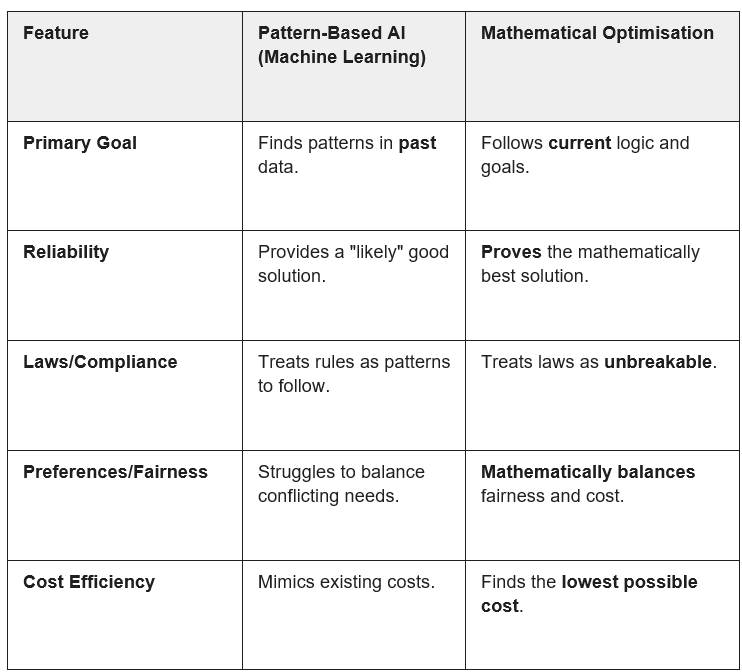
When we talk about automated rostering, we are usually looking at two very different approaches: Pattern-Based AI (often called Machine Learning) and Mathematical Optimisation.
Pattern-Based AI: The Apprentice Who Mimics Habits
Think of typical Machine Learning as a very smart apprentice. It learns by watching you, studying all your past rosters to find patterns. It then tries to create new rosters that look like the “good” ones from the past.
The Limitation: This approach operates on probability. It assumes that because something was done a certain way before, it should be done that way again. If your past rosters contained hidden inefficiencies or high costs, the AI apprentice will simply repeat those habits. It is essentially making a highly educated guess.
Mathematical Optimisation: The Master Puzzle-Solver
Mathematical Optimisation works differently. It is decision-driven. Instead of just looking at what you did yesterday, it looks at your specific rules, your budget, and your goals for today.
The Strength: This approach operates on provability. It doesn't just provide a "likely" solution; it uses advanced logic to sift through trillions of possibilities to find the single most cost-effective and compliant roster possible.
One of the most powerful features of Mathematical Optimisation is its ability to distinguish between two types of rules:
A compelling example involved a fast-food chain with 250 outlets. Traditionally, the Head Chef always opened the store at 7:00 AM to put away deliveries. Because this was "standard procedure," a human planner wouldn't question it, and a pattern-based AI would simply copy it.
But a Mathematical Optimisation model saw something different. It was "blind" to tradition and only looked at the logic: opening tasks don't require a chef's higher pay rate. By assigning those tasks to a junior staff member and starting the chef at 11:00 AM, the system identified $1.8 million in annual savings. It didn't just follow the past; it understood the relationship between skills, tasks, and costs.
In sectors like aged care and disability, following the rules isn’t optional. Whether it’s the 12-hour rest rule or Care Minute mandates, the margin for error has vanished.
An AI tool may see a 10-hour minimum break as a strong suggestion. If it’s struggling to fill a shift, it might create a roster with a 9.5-hour break because that fits the "pattern" of a busy day. This is a compliance breach waiting to happen.
A Mathematical Optimisation tool treats that rule as a Hard Constraint. It is mathematically impossible for the system to produce a roster that violates your Award or EBA. This gives you a rock-solid guarantee of compliance that protects your organization from underpayment scandals and reputational damage.
Moving to "Maths, not Magic" delivers measurable results that go beyond simple scheduling:
Adopting this technology isn't about replacing managers; it’s about giving them "superpowers."
Creating a roster is a mathematically impossible puzzle that can consume hours of a manager's week. By automating this "administrative fog," you free your leaders to focus on what truly matters: coaching staff, resolving conflicts, and improving the quality of care or service. It is an evolution from "clapping together" shifts to true strategic leadership.
The "dream team" of AI and Mathematical Optimisation provides the only viable path forward for modern Australian enterprises: AI to predict the future, and Optimisation to architect the perfect response. It provides the certainty of a compliance guarantee, the strategic agility to respond to disruption, and the financial efficiency to thrive. Don’t settle for “good enough.” Your staff, your clients, and your bottom line deserve the certainty of a mathematic